

Keeping Kids Safe on the Road: A McLean Parent’s Guide to Car Seat Rules
Key Takeaways: Virginia law generally requires every child up to age eight to ride in a federally approved child restraint device, rear-facing until age two or the manufacturer’s minimum forward-facing weight. Restraints generally belong in the back seat, with a narrow exception only when a vehicle has no back seat and no active passenger airbag; minors who have outgrown car seats generally still must wear a safety belt. Limited exceptions exist for documented medical reasons and certain commercial/emergency vehicles, but they’re narrow and often require a physician’s signed statement. A first violation carries a non-suspendable $50 civil penalty, repeat offenses can reach $500, and missing exemption paperwork may add $20, though courts may waive penalties for financial hardship. Notably, Va. Code § 46.2-1095(C) generally bars a violation of Virginia’s child restraint and safety belt article from being treated as negligence, admitted into evidence, or used to reduce damages in a civil injury claim. Parents in McLean whose child was hurt by another driver may still pursue compensation despite a citation, and NHTSA guidance offers an added safety layer on top of these legal minimums.
Virginia generally requires drivers to secure every child up to age eight in a federally approved child restraint device, which cannot face forward until the child turns two or reaches the manufacturer’s minimum forward-facing weight limit. These are the core requirements under Va. Code § 46.2-1095, applying on highways in McLean, from Chain Bridge Road to the Dulles Toll Road ramps. Parents also need to know how the law treats seat placement, medical exceptions, fines, and how a car seat violation may be treated if your family is injured by another driver.
If your child was hurt in a collision caused by someone else, the team at Tysons Trial Law, PLLC is ready to review what happened and explain your options. Call (703) 888-5535 or reach out to our team today to discuss your family’s situation with a Virginia attorney.
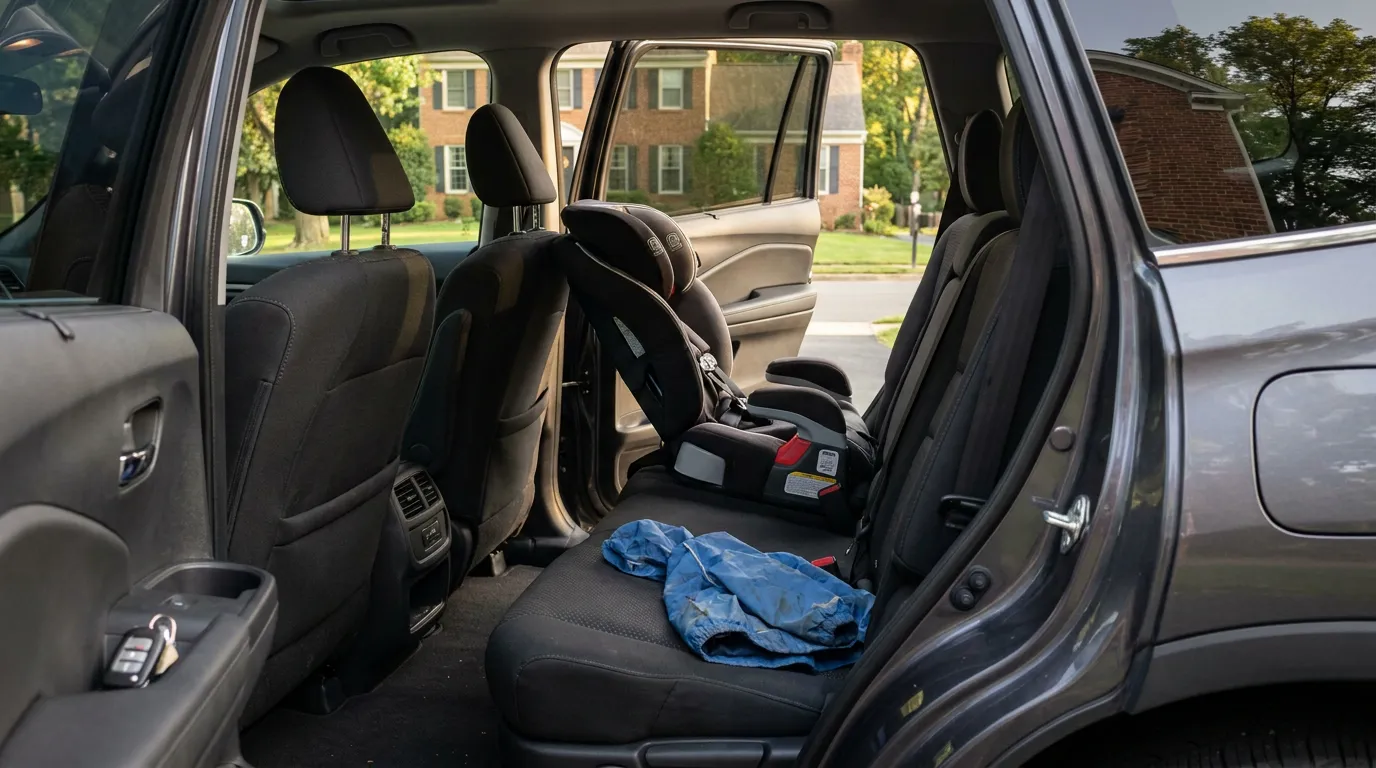
What Virginia Child Car Seat Laws Actually Require
Under Va. Code § 46.2-1095, any driver of a motor vehicle manufactured after January 1, 1968 on Virginia highways must ensure any child up to age eight is properly secured in a child restraint device meeting U.S. Department of Transportation standards. "Up to age eight" means the requirement lasts until the child’s eighth birthday, not a particular height or weight. The restraint may not be forward-facing until the child reaches two years of age or the manufacturer’s minimum weight limit for forward-facing use.
Placement is also regulated. Virginia law generally directs that child restraint devices be placed in the back seat. If the vehicle has no back seat, the device may go in the front passenger seat only when that seat lacks an airbag or the airbag has been deactivated, a narrow carve-out rarely applying to the minivans and SUVs common in Fairfax County.
Older children aren’t left unaddressed once they outgrow a car seat. Under Va. Code § 46.2-1095(B), anyone transporting a person under 18 who isn’t required to be in a child restraint device must ensure that passenger is secured by an appropriate safety belt system, in any vehicle manufactured after January 1, 1968 equipped with such belts. The legal duty to buckle up a minor continues well past the eighth birthday.
Car Seat Requirements in Virginia at a Glance
| Situation | General Requirement Under Virginia Law |
|---|---|
| Child under age two | Child restraint device, rear-facing unless the manufacturer’s forward-facing weight minimum is met |
| Child age two through seven | Federally approved child restraint device, properly secured |
| Seat placement | Back seat, with a narrow exception when no back seat exists and no active passenger airbag |
| Passenger under 18 not in a restraint device | Appropriate safety belt system |
Exceptions Written Into the Child Passenger Safety Law
Virginia’s statutory exceptions are narrower than they may first appear. Under Va. Code § 46.2-1100, a standard seat belt doesn’t violate the article if the child is at least four but less than eight, and a physician licensed in Virginia or another state determines a child restraint system would be impractical due to the child’s weight, physical fitness, or other medical reason. The person transporting the child must carry a signed written statement from the physician identifying the child and the grounds for the determination.
Certain commercial and emergency operators are excluded entirely. Va. Code § 46.2-1095(E) exempts taxicabs, school buses, executive sedans, and limousines from the child restraint requirements. EMS, fire, and law enforcement vehicles receive limited exceptions while performing official duties, and in exigent circumstances where no restraint device is readily available. Va. Code § 46.2-1097 is a separate provision establishing the Child Restraint Device Special Fund.
These exceptions don’t create general permission to skip a car seat. Courts generally read exemptions narrowly, and a vehicle type not listed is generally not exempt. If relying on a medical exemption, keeping the physician’s statement in the glove compartment is a practical step.
💡 Pro Tip: Photograph the physician’s exemption statement as a phone backup, but keep the signed original in the vehicle, since the statute generally requires it to be carried on your person or in the car.
Penalties, Fines, and Financial Hardship Relief
Under Va. Code § 46.2-1098, a first violation of § 46.2-1095 generally carries a civil penalty of $50, which may not be suspended in whole or in part. A second or subsequent violation on a different date may bring a penalty of up to $500, so repeat citations escalate quickly. These are civil penalties rather than criminal fines, generally paid into a state fund helping supply child restraint devices to families in need.
Two additional provisions often surprise parents: an additional $20 civil penalty may apply for failing to carry the physician’s statement required by § 46.2-1100, while a court may waive or suspend the § 46.2-1095 penalty if it finds noncompliance resulted from financial inability to acquire a restraint system, a discretionary form of relief rather than an automatic one.
- A first offense fine is generally $50 and typically cannot be suspended.
- Repeat violations on separate dates may reach $500.
- Missing medical-exemption paperwork may add $20.
- Financial hardship may support a waiver, at the court’s discretion.
Why a Car Seat Violation Does Not Doom Your Injury Claim
Va. Code § 46.2-1095(C) provides that a violation of Virginia’s child restraint and safety belt article shall not constitute negligence, be considered in mitigation of damages of whatever nature, be admissible in evidence, or be the subject of comment by counsel in any action for the recovery of damages in a civil action. In plain terms, an at-fault driver’s insurer generally cannot use a car seat citation to argue your child’s injuries were partly your own doing.
That protection can matter in Virginia, which follows a strict contributory negligence doctrine where defense arguments about a plaintiff’s own conduct can carry outsized weight, though a young child’s conduct generally isn’t imputed the same way an adult’s would be. The statutory bar on using restraint violations as evidence may remove one common line of attack, though other disputed facts, such as speed, distraction, or road conditions, may still be litigated.
Every claim still turns on duty, breach, causation, and damages. Proving those elements generally requires prompt evidence preservation, including scene photographs, vehicle data, and complete medical records. An experienced McLean car accident lawyer can help evaluate coverage issues, including underinsured motorist benefits that may matter in serious pediatric injury cases.
What to Document After a Child Car Crash Injury
Photograph the car seat as installed, the vehicle damage, and the child’s position inside the cabin before anything is moved, if safe to do so. Keep the crash report number, witness contact information, and every discharge instruction from the emergency department or pediatrician.
Children often can’t describe their symptoms accurately, complicating causation. Follow-up evaluations frequently connect a delayed-onset headache, abdominal injury, or behavioral change to the collision. Our library of car accident legal insights covers related evidence and insurance topics in more detail.
Federal Safety Guidance That Supports Virginia’s Rules
The National Highway Traffic Safety Administration’s right seat for your child campaign outlines four stages of child passenger protection, rear-facing, forward-facing, booster, and seat belts, selected by size rather than age alone. NHTSA also offers a car seat finder tool and installation guidance that pair well with Virginia’s legal minimums.
A recurring theme is moving children forward too soon. NHTSA notes the American Academy of Pediatrics recommends children remain in each stage as long as possible before advancing. Because federal materials describe best practices rather than Virginia statutory requirements, following them isn’t itself legally required; parents may treat them as a safety floor layered on top of the Code of Virginia, not a substitute for it.
Replacing a Car Seat After a Collision
Not every crash requires a new seat. NHTSA’s guidance on car seat use after a crash indicates seats generally don’t need replacement after a minor crash, defined by factors like the vehicle being drivable from the scene, no damage to the door nearest the car seat, no airbag deployment, and no visible seat damage. Manufacturers may impose stricter replacement instructions, which should generally be followed.
When a crash doesn’t meet all those conditions, replacement may be the conservative course. Preserve the old seat rather than discarding it, since it may be relevant physical evidence in a claim. Many auto insurers may address replacement costs, which may also be recoverable as property damage.
Frequently Asked Questions
1. Until what age does Virginia require a child car seat?
Virginia law generally requires a federally approved child restraint device for any child up to age eight. After that, the child must be secured by an appropriate safety belt until age 18, subject to statutory exceptions.
2. Can I put a car seat in the front of my truck?
Only in limited circumstances: when the vehicle has no back seat and either lacks a passenger side airbag or has one that’s been deactivated.
3. Will a car seat ticket hurt my child’s injury case?
Generally no. Va. Code § 46.2-1095(C) provides that such a violation is not negligence, is not admissible in evidence, and cannot be argued in mitigation of damages in a civil action, though every case depends on its particular facts.
4. What if I cannot afford a car seat?
A court may waive or suspend the penalty if it finds noncompliance was due to financial inability to acquire a restraint system. This relief is discretionary, and documentation of hardship may assist the court.
5. Does the law apply to Uber and taxi rides?
The statute exempts taxicabs, school buses, executive sedans, and limousines from the child restraint requirements. Transportation network company vehicles aren’t named in that list, so the requirement may well apply to a rideshare trip, parents may wish to bring their own seat.
Protecting Your Family Beyond the Statute
Virginia’s child passenger safety law sets baseline duties: a proper restraint through age eight, rear-facing until at least age two or the manufacturer’s weight minimum, back seat placement in nearly every vehicle, and seat belts for older minors. Penalties under § 46.2-1098 are real but limited, and courts retain discretion in hardship cases. Notably for injured families, § 46.2-1095(C) generally shields restraint violations from being used against you in a civil damages claim, meaning a citation shouldn’t discourage you from exploring whether compensation can be pursued after another driver’s negligence harms your child.
If your child was injured in a crash in McLean, Tysons Corner, or elsewhere in Fairfax County, Tysons Trial Law, PLLC is prepared to help you understand your rights. Call (703) 888-5535 or schedule your case review to talk through what happened and what may come next.
Disclaimer: This content is for informational purposes only and is not legal advice. Every case is unique, and results may vary. Consult an attorney about your specific circumstances.