

When Must Drivers Stop for Pedestrians in Virginia?
Key Takeaways: In Virginia, drivers generally must fully stop, not just yield, for pedestrians crossing in their lane or an adjacent lane. Under Va. Code § 46.2-924, they generally must stay stopped until the pedestrian has passed. The rule covers marked crosswalks, unmarked crosswalks at block ends, and intersections on roads with a speed limit of 35 mph or less. Pedestrians at intersections generally have the right of way over turning cars, and drivers may not pass a car stopped for a pedestrian. Since July 1, 2025, a violation can be a Class 1 misdemeanor if it seriously injures or kills a vulnerable road user who was lawfully crossing. Virginia’s contributory negligence rule and two-year filing deadline make it important to gather evidence quickly and have a lawyer review your claim.
In Virginia, the law generally requires drivers to stop for pedestrians in crosswalks, not just slow down or yield. Under Va. Code § 46.2-924(A), a driver must stop when a crossing pedestrian is in the driver’s lane, or in an adjacent lane and heading toward it, and must stay stopped until the pedestrian has passed the driver’s lane. This covers marked crosswalks, unmarked crosswalks at block ends, and intersections on roads with speed limits of 35 mph or less. Where an officer or traffic signal controls traffic, drivers follow the officer or signal instead. Pedestrians also have duties of their own, which matter a great deal in an injury claim. If a driver hit you in a crosswalk in McLean, Tysons, or elsewhere in Northern Virginia, knowing these rules can help you understand whether you may have a claim.
If you or a family member was seriously hurt in a crosswalk crash, you do not have to deal with the insurance company alone. Tysons Trial Law, PLLC is a women-owned trial firm led by attorney Amy Griggs, and the firm offers free consultations. Call (703) 888-5535 or schedule your free consultation to talk about what happened.
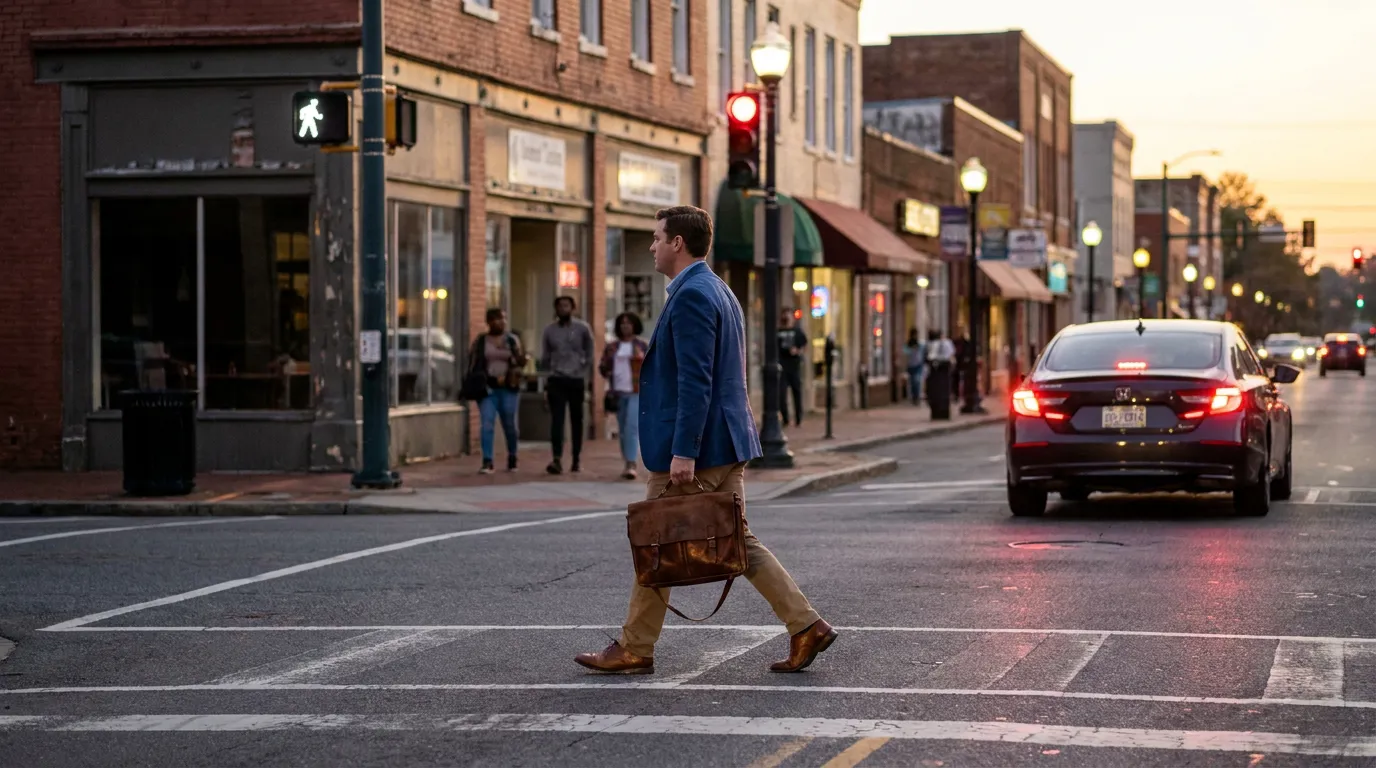
Pedestrian Right of Way in Virginia: What the Statute Requires
Virginia’s main crosswalk statute gives drivers a clear duty to stop. The Virginia crosswalk statute, Va. Code § 46.2-924, says a driver “shall stop” for a crossing pedestrian in the driver’s lane or in an adjacent lane and approaching it. This mandatory stop requirement replaced the statute’s earlier “yield” language through the 2023 Acts of Assembly (Chapter 117); a 2020 amendment had earlier added a duty to stop and remain stopped while the statute was still phrased as a “yield” requirement. Slowing down or rolling through is not enough.
Where the Stop Requirement Applies
The statute lists three places where drivers must stop for pedestrians. Under Va. Code § 46.2-924(A)(1)-(3), the rule applies at:
- Any clearly marked crosswalk, whether midblock or at the end of a block
- Any regular pedestrian crossing at the end of a block formed by extending the sidewalk lines, which is an unmarked crosswalk
- Any intersection where the driver is on a road with a speed limit of 35 mph or less
That third category matters in residential parts of McLean and Fairfax County. On many neighborhood streets and slower commercial roads, a pedestrian crossing at an intersection may be protected even with no painted lines. On faster roads such as Route 7 or Route 123, the question may turn on whether a marked or unmarked crosswalk was there.
Turning Vehicles and Intersections
Pedestrians crossing at intersections have the right of way over drivers turning into the street they are crossing. Va. Code § 46.2-924(C) states that pedestrians crossing highways at intersections “shall at all times have the right-of-way over vehicles making turns into the highways being crossed by the pedestrians.” Turning crashes are among the most common crosswalk crashes at busy Tysons intersections.
Where a police officer or traffic signal controls traffic, drivers must yield as directed. Pedestrians generally must also obey the signals that apply to them. A driver who turns on a green light generally still has to yield to a pedestrian lawfully crossing with a walk signal.
Who Has Right of Way at a Crosswalk With Several Lanes?
When one car stops for a pedestrian, other drivers may not pass it. Va. Code § 46.2-924(B) bars drivers coming from behind, or in an adjacent lane, from passing a car stopped for a pedestrian. This targets a dangerous crash: one car stops, the pedestrian steps out, and a second car goes around the stopped car and hits the pedestrian. These crashes often cause severe injuries, and on multi-lane roads such as Chain Bridge Road or Old Dominion Drive, proof of which lane each car was in can be central to the claim.
| Situation | Driver’s Duty Under Va. Code § 46.2-924 |
|---|---|
| Pedestrian in a marked crosswalk | Stop and stay stopped until the pedestrian passes the driver’s lane |
| Pedestrian in an unmarked crosswalk at a block end | Same duty to stop generally applies |
| Intersection on a road of 35 mph or less | Same duty to stop generally applies |
| Another car has stopped for a pedestrian | Do not pass the stopped car |
| Turning into the street a pedestrian is crossing | Pedestrian has the right of way |
| Signal or officer controlling traffic | Yield as the signal or officer directs |
Special Crosswalk Rules for McLean and Fairfax County
McLean drivers may face added duties under a Northern Virginia part of the statute. Va. Code § 46.2-924(D) lets certain localities, including Arlington County, Fairfax County, Loudoun County, the City of Alexandria, the City of Fairfax, and the City of Falls Church, pass ordinances to put up signs at marked crosswalks requiring drivers to yield to or stop for pedestrians. A driver who ignores these signs commits a traffic infraction with a fine of $100 to $500. These rules do not apply to limited access highways.
Shared-use paths add another layer. Under Va. Code § 46.2-924(E)-(F), where a shared-use path crosses a road at a marked crosswalk with no traffic signal, a locality may require path users to come to a full stop before entering, with a fine of up to $100.
Penalties for Drivers Who Break Virginia Pedestrian Laws
A driver who breaks the crosswalk rule generally commits a traffic infraction, but the penalty can be much higher. Under Va. Code § 46.2-924(A), a violation becomes a Class 1 misdemeanor if it causes serious bodily injury to, or the death of, a vulnerable road user who was lawfully crossing. These higher penalties took effect July 1, 2025.
A criminal or traffic charge is separate from a civil injury claim. A ticket or conviction can be useful evidence, but it does not decide whether you will recover money. A driver who was not charged may still be found negligent in a civil case. Your claim generally depends on proving duty, breach, causation, and damages under Virginia negligence law.
💡 Pro Tip: Ask for the police report number at the scene, or request it soon after. The report may show whether the driver was cited under Va. Code § 46.2-924 and may list witnesses you would otherwise have trouble finding.
Why Pedestrian Duties Matter in a Crosswalk Accident Claim
Virginia’s contributory negligence rule makes the pedestrian’s own conduct a key issue. Virginia follows pure contributory negligence. A pedestrian whose own negligence helped cause the accident, even slightly, may be barred from recovering anything. Insurers often argue that the pedestrian stepped out suddenly, was distracted, or crossed against the signal.
The statute gives pedestrians their own duties. Va. Code § 46.2-924(C) provides that “No pedestrian shall enter or cross an intersection in disregard of approaching traffic.” Having the right of way does not let a pedestrian ignore oncoming cars.
When Fault Is Disputed
A dispute over fault does not always end a claim. When an insurer blames the pedestrian, Amy Griggs looks closely at the evidence and considers whether rules such as last clear chance may apply. Under that rule, a driver who had the last clear chance to avoid hitting a pedestrian may still be held responsible in limited cases. These issues depend heavily on the facts, and no outcome can be promised. You can also learn more about your options after being hit by a car.
Protecting Your Claim After a McLean Pedestrian Accident
What you do in the days after a crash can affect the strength of your claim. If you can, take these steps:
- Get medical care right away, even if you think your injuries are minor
- Photograph the crosswalk, signals, signs, lighting, and your injuries
- Get the names and contact information of witnesses
- Ask nearby businesses and traffic camera operators to save their footage
- Keep records of medical bills and missed work
- Decline to give a recorded statement to the driver’s insurance company
Deadlines also apply. Under Va. Code § 8.01-243(A), Virginia personal injury lawsuits generally must be filed within two years of the injury. Wrongful death claims generally must be filed within two years of the death. Claims against the Commonwealth or a locality may require written notice much sooner, sometimes within six months to one year.
Working with a pedestrian accident lawyer Virginia residents trust can help you preserve evidence while you focus on healing. Amy Griggs prepares every case for trial, and that approach shapes how she gathers evidence from the start. You can read more about how the firm handles crash cases on its pedestrian accident lawyer Virginia page.
Frequently Asked Questions
1. Do drivers have to stop or just yield for pedestrians in Virginia?
Drivers generally have to stop. Under Va. Code § 46.2-924(A), a driver must stop for a crossing pedestrian in the driver’s lane or in an adjacent lane approaching it, and stay stopped until the pedestrian has passed.
2. Does a pedestrian have the right of way in an unmarked crosswalk?
In many cases, yes. The duty to stop generally covers unmarked crosswalks at the end of a block, as well as intersections on roads with speed limits of 35 mph or less.
3. Can I recover money if the insurer says I was partly at fault?
Possibly, but Virginia’s contributory negligence rule makes this a serious issue. A pedestrian whose own negligence helped cause the accident, even slightly, may be barred from recovery. In limited cases, rules such as last clear chance may apply.
4. What happens if a driver passes a stopped car and hits me?
That driver may have violated Va. Code § 46.2-924(B), which bars passing a car stopped for a pedestrian. This may be strong evidence of negligence in a civil claim.
5. How long do I have to file a pedestrian injury lawsuit in Virginia?
Generally, two years from the date of the injury under Va. Code § 8.01-243(A). Claims against government entities may have shorter notice deadlines.
Know Your Rights Before You Talk to an Insurer
Virginia law generally gives pedestrians strong protection at crosswalks, but those protections may only help if you can prove what happened. Because contributory negligence can bar recovery, quick evidence gathering and careful legal review matter.
If you or a loved one was seriously injured in a crosswalk in McLean, Tysons, Fairfax County, Arlington County, or Alexandria, Tysons Trial Law, PLLC can review your case at no cost. The firm works on contingency, so you pay no fee unless the firm recovers money for you. Call (703) 888-5535 or request your free consultation today.
Disclaimer: This content is for informational purposes only and is not legal advice. Every case is unique, and results may vary. Consult an attorney about your specific circumstances.